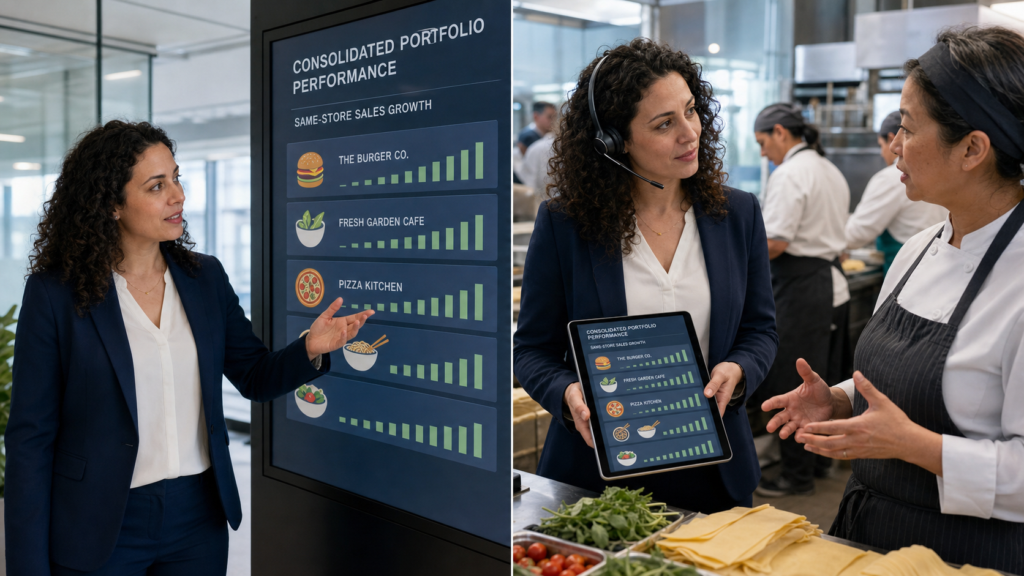

In the restaurant industry, the pressure is relentless. Between thin margins and rising expectations, the cost of a financial misstep is higher than ever.
Operators know they need to track performance, but too often, benchmarking is mistaken for a simple game of comparison, measuring yourself against other brands.
The reality is, true benchmarking in restaurants has little to do with comparison and everything to do with achieving clarity.
Top-performing restaurant groups treat benchmarking not as a vanity exercise but as a leadership tool. It’s how they align their teams, forecast with discipline, and measure progress in a way that drives profitability week after week.
They don’t just look at numbers. They use them to spark operational change, reset habits, and earn stakeholder confidence.
This post covers the financial and operational benchmarks worth tracking and shows how steady systems and routines turn numbers into better decisions, stronger accountability, and real momentum.
Every restaurant group needs one thing before setting benchmarks or targets: a clear view of cash.
That means knowing exactly what’s coming in, what’s going out, and what’s ahead, across all accounts each week. Without this visibility, even the best budgeting efforts fall apart.
Operators end up reacting to fire drills, making short-term decisions, and losing trust with partners and stakeholders.
The best way to build that clarity is with a rolling cash flow model: five weeks of actuals paired with a 13-week forecast.
This setup gives teams a live view of how money moves through the business and where pressure points or breathing room appear.
In many turnarounds, this is the first step. Before tackling labor costs or food margins, focus on stabilizing cash flow and building a habit of reviewing it. Once that foundation is set, real benchmarking can begin.
With cash steady, Global Shared Services (GSS), a finance and accounting partner built for multi-unit restaurants, guides teams through a clear sequence: labor discipline first, then COGS control, and finally EBITDA expansion.

When profits fall or cash runs thin, the instinct is often to push for more sales. But sustainable improvement rarely comes from revenue alone.
Real progress starts with seeing how efficiently each dollar is used and whether the operation is performing to its potential.
Through its CFO support services, GSS helps owners, operators, and finance leaders set benchmark targets based on real data from its network of multi-unit restaurant groups, ensuring performance goals are practical and actionable.
Food and beverage costs are among the most controllable and revealing parts of restaurant finance. In high-performing concepts, COGS typically lands in the low 20% range of total sales. When it rises above that, it often points to deeper issues such as inconsistent portioning, waste, or pricing misalignment.
The same logic applies to labor. While staffing needs vary, the best-run restaurant groups keep labor in the low 20% range by pairing guest experience with disciplined scheduling and forecasting. If labor spending feels chaotic or unpredictable, it’s often a sign that financial visibility is lacking.
COGS and labor drive the results that show up in EBITDA. For most restaurant groups, a healthy EBITDA range is between 10–20%, with store-level top performers exceeding that. Falling below often signals broader structural issues such as outdated workflows, underperforming teams, or weak alignment between finance and operations.
Benchmarking provides valuable insights beyond mere numbers. These aren’t arbitrary targets or imitations of competitors; rather, they reveal successful strategies from comparable restaurants, offering teams a clear vision of optimal performance.
When paired with a solid operational structure, they give teams a clear point of focus week after week.
If financial metrics show what’s happening, operational benchmarks reveal why, and they create the discipline to fix it. The most successful restaurant groups treat these benchmarks as both a management system and a leadership tool, building habits of accountability through two layers of data: internal process metrics and customer-facing performance metrics.
The foundational internal tool is a rolling forecast: five weeks of actuals paired with a 13-week outlook. This model gives operators a real-time view of cash and labor, showing exactly where money is going and how accurately teams are projecting it. The discipline begins here: each location must submit a detailed four-week labor forecast every week.
That requirement changes behavior. It sets a weekly habit of accountability and a simple loop: forecast, review, adjust. Gaps in planning and execution surface quickly. For one GSS client, this weekly rhythm made it immediately clear who was engaged with the numbers. Leaders could spot anomalies, like a sudden spike in host costs, before they became problems. Within a year, the group’s renewed discipline helped lift EBITDA from $7 million to $9 million, a $2 million+ profit increase.
Beyond financial visibility, operational benchmarking connects directly to the guest experience. When staffing and labor forecasts are built on data instead of instinct, service runs smoother, teams feel supported, and customers notice the difference. Overstaffing leads to waste; understaffing causes burnout. Both show up in slower service, lower morale, and eventually lost revenue.
To connect the two, GSS pairs financial forecasting with store-level indicators that explain the “why” behind the numbers:
These metrics, combined with structured weekly reporting, turn benchmarking into a shared weekly routine. Store-level teams learn to act early, adjust faster, and perform better week after week.
Finally, this discipline builds external trust as well as internal alignment. Clean, consistent reporting demonstrates control and progress to banks and investors, making it easier to rebuild credibility during technical defaults or capital negotiations. For GSS clients, weekly forecasting becomes more than an internal exercise; it shows the business is stable, based on data, and moving forward.

Financial benchmarking helps restaurants see what’s working, what’s not, and what needs to change. It serves as a leadership tool, not a scoreboard.
When done well, benchmarking can help restaurant groups to:
Ultimately, this approach fosters continuous improvement. The aim is not to achieve an elusive perfect figure, but to establish a system that highlights progress, promotes shared accountability, and ensures decisions are data-driven, rather than based on speculation.
If your business is navigating late closes, pressure from lenders, or an urgent need for better forecasting, consider a 30-Day CFO Services Trial from GSS. With over 20 years of experience, GSS helps operators regain financial control, align their figures, and rebuild stakeholder trust.